The Myth of "I've Got Nothing to Hide"
Why believing you will never be a victim of cybercrime is dangerous
I know I've heard it at least 10,000 times...
As we approach another holiday season, anyone who is technically inclined enough to know what a browser is — and that the mouse is, in fact, not a foot pedal — suddenly becomes the entire IT department at every family gathering.
Before you know it, you’re triaging network issues over pumpkin pie and trying to use a cable box to get the Wi-Fi working because your mom swears that’s the box the painters unplugged when they re-carpeted the living room (true story). Tech people alone probably account for a healthy percentage of liquor sales during the holidays.
Eventually — much like Santa bringing coal to misbehaving children — the conversation shifts to cyber hygiene. You talk about passkeys. You explain two-factor authentication. You casually mention how many times Aunt Millie’s email address showed up on Have I Been Pwned.
And then, like clockwork, one phrase reigns supreme:
"What would they want with me? I've got nothing to hide!"
We smile, laugh, and recoil from the subject like Ralphie asking for an official Red Ryder, carbine action, two-hundred shot range model air rifle.

And to be fair… those feelings aren’t completely unwarranted — at least on the surface. Here are Some of the Most common myths:
Myth 1: Bigger Phish to Fry
As Russell Crowe’s character Richie Roberts says in American Gangster, “Follow the money.” We tend to apply that same logic to cybercrime.
In our minds, cybercriminals want what we physically associate with value: money, luxury items, assets — things we can see, touch, and flaunt on Instagram. We imagine attackers only going after the wealthy, the powerful, or “bigger fish” who actually have something worth stealing.
Theft, in our minds, is still a very physical act:
Person X takes Person Y’s stuff.
Since most of us don't have a bank account with more than a couple 0's or a catamaran on the French Riviera, we believe that those risks are for the people that can afford bodyguards.
We subconsciously adopt what I jokingly call the Qui-Gon Jinn Theory of Cybersecurity:
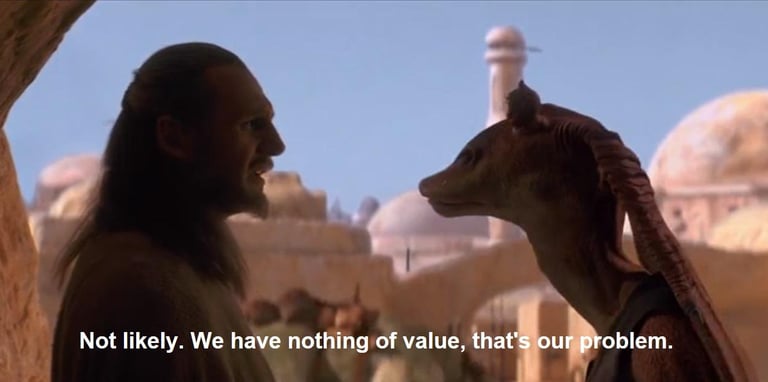
“Security feels unnecessary until it feels urgent.”
One of my favorite cybersecurity goons Jayson E Street once said, and I quote often, "If you want a fire prevention plan in your building tomorrow, burn down the building across the street today."
That single quote explains most of the public’s relationship with cybersecurity.
We only care when something is on fire.
The problem is that the media almost exclusively shows us which buildings are allowed to burn.
Turn on the news and it’s always the same stories:
Nation-state hacking groups like Russia and China.
Big Critical infrastructure companies targeted.
Hospitals being ransomwared.
Pipelines shutting down fuel delivery.
Mega-corporations hemorrhaging millions.
It quietly trains the public to believe a simple rule:
Hackers go after countries and corporations. Not me.
Your brain fills in the blank:
“I’m not a hospital.”
“I’m not a billion-dollar company.”
“I don’t run a pipeline.”
So the threat gets mentally filed into the “Important People Problems” folder.
Myth 2: I control my privacy Online
We are now, more than ever, willing to trade our privacy for convenience and I don't even think we realize how much we give away. Remember all of those Terms of Service you rapidly scroll through for social media, your new smart IoT device, or subscription service? You are probably giving away more than you think. There is a very ominous quote that we have all heard, but I think very few have actually come to terms with:
"If you don't know what the product is, it's YOU!"
Companies like Facebook, Instagram, TikTok, and others make billions of dollars a year paid by advertisers to deliver you catered advertisements based off of what you click on, search for, and do within their platforms. We joke that our phones and smart devices are listening in on us, as what we say quickly shows up in our own personal algorithm. If you have ever engaged with the internet, your data is out there somewhere.
Every bank, toll service, restaurant, concert hall, and even your local dog park has an app in the modern age, with may of them being proprietary. Want to access your tickets to your son's high school football game? Buy ahead through our app! Want to transfer money to a savings account? Just login to mobile banking from the comfort of home! Want a text message when your prescription is ready at the pharmacy? Make sure you register your phone number. Don't get me started on so-called "loyalty cards"...
You didn’t give up privacy because you were careless, you gave it up because it was easier. You gave it all away with a click on "Accept Terms of Service"...
Myth 3: Hacking is too technical to do at scale
There’s another quiet assumption baked into “I’ve got nothing to hide” that doesn’t get said out loud: "Sure, cybercrime exists… but it’s complicated. Someone would have to really know what they’re doing."
Whenever hackers are seen in TV or movies, we all think of Ethan Hunt rappelling down from the ceiling to hack a computer in Mission Impossible or the operators in The Matrix, with tool belts full of equipment, genius-level knowledge, and a knack for reading Japanese sushi recipes (if you know, you know...)
Hollywood taught us that hacking is a skill sport — elite, difficult, and targeted. Something that requires planning, precision, and a very specific victim.
Reality looks a lot less like a heist movie and a lot more like a spam factory.
Modern cybercrime doesn’t scale because criminals are manually typing faster than everyone else. It scales because they don’t have to type much at all. The hard technical work gets done once — writing a script, building a toolkit, buying a database — and then it runs over and over and over again.
No one is personally selecting you from a list because your life is fascinating. A bot doesn’t know you exist. It’s just trying billions of combinations against millions of accounts and seeing what sticks.
It’s not precision targeting. It’s industrialized opportunism.
And when something is automated, your “unimportance” stops being a shield and starts being a statistic.


Myth 5: I’d know if I was hacked
Most people imagine cyber incidents like a smash-and-grab robbery. Something obvious. Alarms blaring. Accounts drained. Passwords changed. Digital chaos.
But a huge percentage of compromises are quiet.
Your password gets exposed in a breach you never hear about. Months later, it’s tested automatically against dozens of other services. One works. No one logs in right away. The access gets bundled and sold. Eventually it’s used to send scams, reset other accounts, or pivot into something bigger.
You don’t notice because nothing “happened” — yet.
Cybercrime often works on delay. Data is collected, sorted, resold, and reused like raw material. Victims frequently don’t connect the dots because the cause and the effect are separated by time, distance, and different platforms.
You assume you’d see the smoke.
But most of the time, by the time you see flames, the fire started somewhere else entirely.
Myth 4: If something happens, my bank will just fix it
This one sounds responsible on the surface. We’ve all heard it:
“That’s why I use a credit card.”
“The bank will reverse the charges.”
“I have fraud protection.”
And to be fair, consumer protections in many places are strong. You might get your money back.
But reimbursement is not the same thing as prevention.
Banks refund fraudulent transactions because it’s cheaper than losing customer trust. That doesn’t mean the crime didn’t work — it just means the cost gets absorbed somewhere else. Higher fees. Higher interest rates. More aggressive monitoring. More friction for everyone.
And money isn’t the only thing at stake.
Banks can reverse a charge. They can’t un-open an account that was opened in your name. They can’t un-send phishing emails from your hijacked account. They can’t rewind the hours you’ll spend on the phone proving you’re you.
The “I’ll get my money back” mindset treats cybercrime like a temporary inconvenience. For criminals, it’s a low-risk business model with built-in loss insurance — funded by all of us.
You're far more valuable To cybercriminals than you may think...
Your Data’s Value Is in Aggregation, Not Uniqueness
Cybercriminals think about things like your personal data a little bit differently. While it is true that "whaling" (the targeting of executives/high net worth individuals) and "big game hunting" (the targeting of large, high profit companies) are tactics observed within many threat actor groups on all levels, it is hardly the norm and is often not highly profitable. These whales and big game are often locked down tighter than Fort Knox behind layer upon layer of security controls. For many threat actor crews, the amount of effort needed to compromise these individuals or companies is not always worth the payoff potential. Attacking these individuals or companies requires an advanced skillset to crack these many layers of security and not get caught, making it not a game worth playing for many.
Like any good investment firm, threat actors therefore are always looking for different revenue streams to diversify their portfolios. This is where you come in -- Playing against you has far better odds!
Let's use a lottery analogy. Think of cybercriminals targeting whales and conducting big game hunting as buying one ticket for the MegaMillions jackpot. Try as you might, you have infinitesimally small odds of success for an incredibly high payout of several billion dollars. You are also 100% betting on a single, linear path to victory (i.e. this one ticket either succeeds or fails).
Now think of a data breach impacting you and a hundred thousand of your closet friends' email addresses attached to a banking app. Let's say, for the sake of math, that each one of you has $250 in your account. Think of each email address as a lottery ticket in our analogy. Therefore, each "ticket" has a max payout of $250 within this banking environment, with a max payout of $25 million. This time you have multiple lines that could payout $250 each, instead of an all-or-nothing approach like with whaling or big game hunting. Even if you only have a 5% success rate across all your "tickets," you still walk away with $1.25 million. This ends up being far more profitable at scale.
You see, you're not hunted -- You're harvested. You aren’t targeted because you matter, You matter because you’re easy to scale.
Scaling is Big business
You can’t go a day without hearing about the “Nigerian Prince,” scam texts about unpaid tolls, urgent warnings that you owe a bill in Bitcoin, or phishing emails pretending to be your bank.
Those are the loud, obvious scams — the digital equivalent of someone in a ski mask trying your car door handles in a parking lot.
But that’s just the street-level stuff.
Behind the scenes, cybercrime has evolved into something far more structured, automated, and profitable than most people realize. It’s less like random hustlers throwing darts and more like an industry built on data pipelines, resale markets, and repeatable processes.
Your information doesn’t just get stolen and used once. It gets:
Collected
Sorted
Bundled
Sold
Resold
Tested
Automated
Scaled
Over and over again.
And the people doing this aren’t always lone geniuses in hoodies. Many are running operations that look more like startups than movie villains — complete with customer support, pricing tiers, and service guarantees.
The reason this works is simple: your data is reusable.
A password exposed in one breach becomes a key tested against dozens of other sites.
An email address becomes a phishing target, a spam target, and an account recovery path.
A phone number becomes a SIM swap opportunity, a social engineering prop, or a way to bypass security checks.
Individually, each piece of data about you feels boring.
At scale, it becomes inventory.
Below are a few examples of how that inventory gets used in ways most people never see coming — each one powered not by how interesting you are, but by how efficiently your data fits into a larger system.
🎯Credential Stuffing
When one password leaks, bots automatically try it across banks, shopping sites, streaming services, and more. No one is “hacking you” directly — they’re letting automation test whether you reused a password somewhere valuable.
💬Account Takeovers
Your email, social media, or financial accounts don’t just hold information — they hold access. Once inside, criminals can reset other passwords, impersonate you, or sell that access to someone else.
🏡Home Title Theft
Property records are public in many places. With enough personal data, criminals can attempt to fraudulently transfer ownership of a home or take out loans against it — turning identity data into real-world assets.
🧩Synthetic Identity Fraud
Instead of stealing your identity outright, criminals combine pieces of real data (like your Social Security number or birthdate) with fake details to create a brand-new “person” who can open accounts and build credit.
📳Smart Device Takeovers
That smart camera, baby monitor, router, or thermostat isn’t just a gadget — it’s a computer on the internet. Compromised devices are often swept into botnets and used to power attacks against other targets.
So… What Do They Want With You?
When people say, “I’ve got nothing to hide,” what they usually mean is:
“I’m not rich.”
“I’m not famous.”
“I’m not running a government agency.”
“I’m not interesting enough to hack.”
And that logic makes sense — if cybercrime were about secrets, drama, or targeting specific people.
But it isn’t.
Modern cybercrime is about access, automation, and scale.
It’s about taking tiny, ordinary pieces of information from millions of people and turning them into something useful, resellable, or exploitable. It’s not personal. It’s industrial.
You’re not being singled out because your life is fascinating.
You’re part of a dataset.
A credential list.
A breach dump.
A phone number pool.
An email collection.
Individually, you may not look like much.
Collectively, you’re inventory.
That’s the mental shift most people never get to make. We still think about digital crime like physical theft — one thief, one victim, one stolen thing. But online, the economics are different. Low effort beats high drama. Automation beats precision. Volume beats value.
You don’t need to be wealthy to be profitable.
You just need to be reachable.
And in a world where our finances, homes, conversations, memories, and identities all live behind usernames and passwords, “reachable” describes almost all of us.
This isn’t about fear. It’s about understanding the game that’s actually being played.
Because once you realize you’re not being hunted — you’re being harvested — cybersecurity stops feeling like paranoia and starts looking like basic self-defense.